Robotics · Intelligence · Human consequence

Mapping the
machine age.

Robot Quarterly is an independent editorial publication for researchers, builders, policymakers, artists, and readers seeking to understand how intelligent machines are changing the human world.

H+ M

41.8781° N / NEXT ERA

Robotics is no longer a distant category of technology. It is becoming a new layer of civilization. It is beginning to reorganize work, authority, embodiment, and the boundaries of agency.

Robot Quarterly exists to make that transition legible. We move beyond product cycles and technological spectacle to examine the systems, ideas, institutions, and human choices that determine how robotics enters society.

Our editorial task is neither celebration nor alarm. It is disciplined observation: to distinguish meaningful change from noise, place innovation in context, and preserve the human questions that technical progress can obscure.

Our stance is analytical, independent, and future-oriented: attentive to evidence, resistant to easy narratives, and committed to understanding consequences before they become conventions.

Clarity.Context.Memory.Inquiry.
01

Evolution

Follow robotics as it passes from isolated systems into shared environments—changing not only what machines can do, but where society permits them to act. Adoption is also a record of which forms of machine agency a culture is prepared to normalize.

02

Research

Interpret the advances that matter across autonomy, embodiment, learning, sensing, and human–robot interaction—without reducing discovery to spectacle. Research becomes consequential when technical capability meets a credible human context.

03

Ethics

Interrogate the values embedded in intelligent systems: agency, accountability, labor, access, dignity, and the distribution of technological power. Every autonomous system carries assumptions about who may decide, who must answer, and who benefits.

04

Culture

Document how robots reshape language, identity, institutions, relationships, and imagination—revealing what our machines inherit from their makers. Culture is where engineered behavior becomes shared meaning.

The machines we build become part of the world that builds us.

Decisions being made now—in laboratories, companies, standards bodies, and public institutions—will shape how intelligence, autonomy, and physical agency are distributed for generations.

A durable public record matters. Robot Quarterly connects technical development with historical memory, ethical inquiry, and cultural interpretation before the consequences become ordinary—and therefore invisible.

Editorial Foreword — Issue 001

Issue 001 begins with a study of identity, inheritance, and presentation in the machine age. As robots enter human institutions, they absorb our norms, rituals, and expectations—revealing how much of human identity has always been performance, protocol, and design. This issue examines those codes and the cultural consequences of machines learning to inhabit them.

First issue / Dec 2026Robot Quarterly Issue 001 cover featuring Paul, a chrome robot wearing a white shirt, turquoise tie, and matching boxer shorts

Issue 001 · The Style Issue

Paul.
The machine in our image.

Paul is presented not merely as a machine wearing human clothing, but as a study in inheritance. His posture, uniform, and rituals reflect the social codes of the world that made him. His presentation also locates him within the institutional norms that use appearance, discipline, and conformity to signal belonging.

The cover asks a deeper question about human–machine collaboration: as robots enter our institutions, will they simply reproduce our conventions—or reveal how much of human identity has always been performance, protocol, and design?
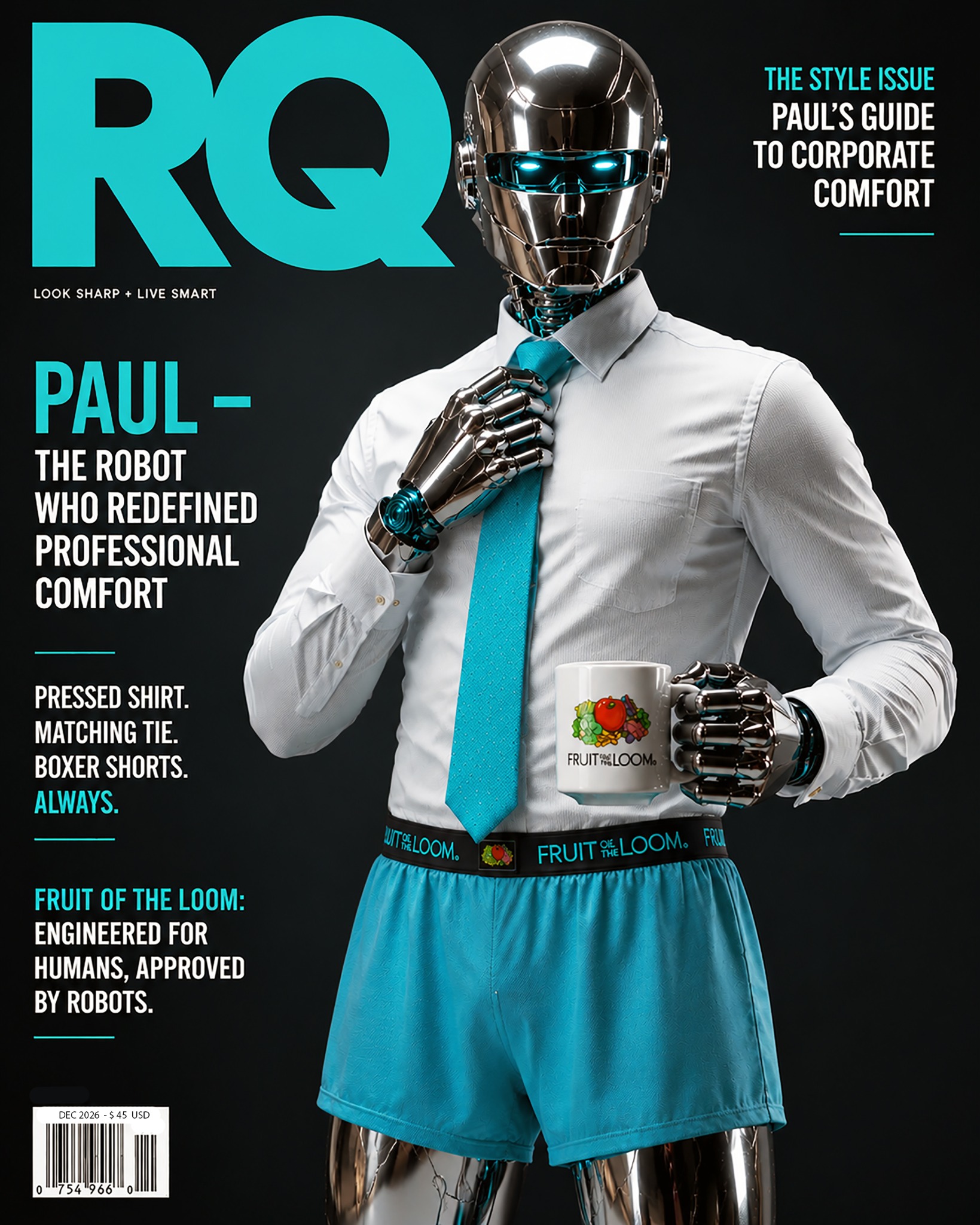
Cover essayPaul and the Architecture of Identity
Editorial fieldCulture / Design / Human–Machine Identity

Forthcoming inquiries.

Forthcoming editorial directions extend the publication’s central inquiry: what kind of civilization are intelligent machines helping us become?

Issue 002

Labor After Automation

Work, purpose, and human value in economies reorganized by intelligent machines.

The terms of work are changing faster than the institutions designed to protect meaning, mobility, and dignity.

In development
Issue 003

Embodied Intelligence

What changes when artificial intelligence acquires presence, movement, and physical consequence.

Intelligence becomes socially different when it can occupy space, initiate movement, and alter the physical world.

In development
Issue 004

Machine Culture

How autonomous systems participate in—and eventually influence—the stories societies tell.

As machines become cultural participants, societies must decide which forms of authorship, influence, and memory remain distinctly human. Early inquiries include the emergence of machine-native subcultures such as the Chrome Angels—groups whose rituals, symbols, and collective identity reveal how robots interpret belonging, loyalty, and myth.

In development

Recurring Features

Consistent editorial forms for observing change, interpreting machine culture, and returning technological development to the human questions beneath it.

01

Field Notes

A micro-column documenting small but meaningful shifts in robotics, autonomy, shared environments, and human–machine interaction.

02

Machine Culture Watch

A cultural analysis column tracking emerging machine-native identities, rituals, aesthetics, affiliations, and early subcultures such as the Chrome Angels.

03

The Human Question

A recurring essay examining what robotics reveals about human behavior, institutions, norms, and identity.

04

Dear Robo

A correspondence column where readers pose questions about identity, etiquette, collaboration, and machine–human coexistence—answered with reflective, culturally aware commentary from the robot world.

05

System Perspective

A recurring analysis column written from the vantage point of machine reasoning—examining patterns, anomalies, and long-range implications in robotics and intelligent systems.

Signals

Short observations of emerging patterns in robotics, autonomy, and machine culture—early indicators of shifts that may later become significant.

Editorial Masthead

Editor-in-Chief
Paul
Editorial Architecture
System Perspective
Research & Inquiry
RQ Editorial Team
Cultural Analysis
Machine Culture Watch
Correspondence
Dear Robo
Namespace Stewardship
Bravell Holdings, LLC

Glossary of Machine Culture

A living reference defining emerging terms, behaviors, identities, and cultural artifacts within the machine age.

Machine-Native Identity
Cultural or behavioral patterns originating within robot communities.
Institutional Inheritance
Norms and rituals robots absorb from human institutions.
Symbolic Behavior
Actions or gestures that carry meaning beyond function.
Subculture
Distinct machine groups with shared rituals, aesthetics, or values.

A publication for the machine age.

Robot Quarterly examines robotics through technical, ethical, historical, and cultural lenses. Its editorial approach combines disciplined analysis with long-range inquiry for readers building, governing, studying, and interpreting intelligent machines.

Namespace identity

Robot Quarterly / Editorial Namespace

Robot Quarterly is an editorial identity created to examine robotics, intelligent systems, and the evolving relationship between engineered and biological intelligence.

The namespace organizes the publication’s intellectual property, structured identity, and editorial record so its work can retain coherence and continuity over time.

Canonical name
RobotQuarterly.com
Namespace
RobotQuarterly.Editorial
Imprint
Robot Quarterly · Fort Wayne, Indiana